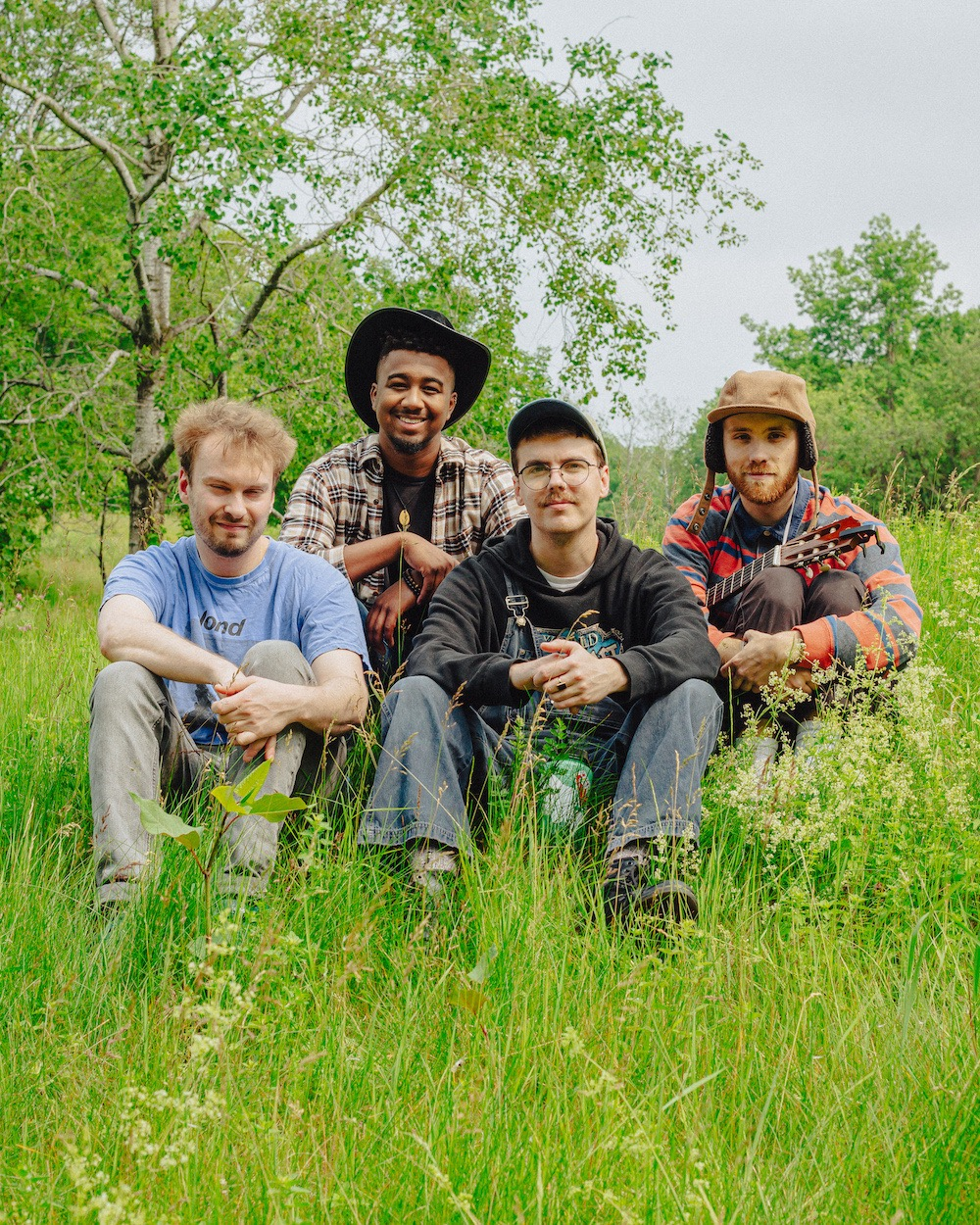
Tiberius has always lived in the space between noise and stillness, and their latest album Troubadour sharpens that tension into something deeply personal. Written during a period of upheaval, Brendan Wright describes it as an “ego death”. In our conversation with Brendan, he talks about growth, discomfort, and why sometimes the most honest thing an album can be is a tree.
ATN: For those unfamiliar with Tiberius, how would you describe your sound in five words?
BRENDAN WRIGHT (BW): Confessional, Emo, Rustic, Tree, Psychedelic
ATN: How did Tiberius come together?
BW: Tiberius started as a bedroom project for me to experiment with songwriting in college, and eventually grew into a band of pals who were gracious and interested enough in playing my songs to people in the real world and not just over the internet.
ATN: You released your new album Troubadour in November, and it’s been described that the album is coming out of a period of “ego death” and profound change. How did that experience shape the emotional arc of the record?
BW: I suppose when stuff happens in my life I just try to be observant of the stimuli around me and write about how it might affect me. After a while, I start to get these bits and pieces of a bigger story unfolding in front of me that becomes pretty natural to shape into a record. During this period specifically there was a lot of change going on in my life, friends moving away, relationships coming and going, and really not understanding who you are without your cheerleaders around you.
ATN: There’s a raw duality in the album from intense and ambient to angry yet gentle. How intentional was that contrast, and how did the expanded band lineup shape it?
BW: I love contrast. I think part of that comes from the fact that whenever I try to write a quiet song I just can’t help myself from clicking on my distortion pedal and really getting fuzzy. I think it’s also nice in a live context to make sure people don’t get too bored standing there. More than anything else, I’m a moody person, and I feel like experiencing the world pretty dramatically from day to day, moment to moment. I think the music really reflects that.
ATN: What does “Farm Emo” mean to you, and how does that label help or undermine the expectations around your sound?
BW: It’s hard to describe the band. It’s confessional, loud, quiet, country, psychedelic, shoegaze, screaming, indie, whatever, whatever. I think farm emo kind of gets at the dichotomy of the two biggest elements. It’s loud and emo but has some really rustic and confessional moments. And it’s better than just saying, “We’re an indie band”.
ATN: Nature clearly played a grounding role during the writing of Troubadour. What’s the relationship between the rural or natural imagery and your internal journey on the album?
BW: I think there are a few levels to this, but prominently I think that there’s a subtle dichotomy within the album between loud and quiet, industrial raucous, peaceful and chill. As the character in the album transitions to a more grounded place the music becomes more farm.
ATN: “Sag” taps into the pressure and comparison game so many artists feel. Do you think staying in Boston helped sharpen your voice rather than dilute it in bigger markets?
BW: That’s a good question. I don’t know if I could totally answer that, not experiencing the other side of that coin, however I do think that there’s a privilege to staying in a place. I certainly think staying in Boston has given me an opportunity to refine Tiberius, but I do wonder about the advantage of getting a change of scenery in other places. Traveling across the country had a huge influence on the writing of this record.
I do think that most ‘bigger’ markets don’t need another band like mine – they already have it 70 times over.
ATN: In “Felt,” you reflect on using distraction to avoid sitting with loneliness. How did songwriting help you confront that fear, if at all?
BW: Songwriting always helps confront what’s lingering in the background. Perhaps it’s a longer pattern of self loathing, or perhaps in a more forgiving lens, I thrive the best when my issues are laid out in front of me. Saying it aloud keeps me accountable to deal with it. And it’s grounding to sing it.
ATN: “Moab” feels deeply vulnerable, even self-critical in hindsight. Was there hesitation in releasing something that shows you in that state, or was it part of the healing?
BW: There was hesitation around this entire record. I do think that to some degree, I’m pretty used to being self critical and vulnerable in the music I write. I feel like sometimes if it’s hard for me to say it, then maybe it’s important that it’s said. There are probably other folks who feel like that who might resonate with it.
But it’s for that reason, that I try to keep all my feelings about me. I don’t feel like it’d be okay to try to recreate a voice that isn’t mine.
ATN: Can you talk about “Painting of a Tree” and how that one comment from your coworker bloomed into a track about heartbreak and perspective?
BW: I asked an older coworker how one might deal with heartbreak, and after thinking about it he told me that “an artist can only paint a tree if they examine all aspects of it”. It’s accepting that heartbreak is a part of the human experience. It’s not only inevitable, but necessary to being human. It helped me own that experience.
ATN: This was originally a solo project. What was the tipping point for expanding into a four-piece band, and how has that impacted your writing?
BW: I never had the intention of turning Tiberius into a band. I never felt comfortable telling other people what to do. It wasn’t until a friend in college actually put a band together for me, that I gave it a try. Since then, and probably unsurprising to someone on the outside, I’ve found that the songs are elevated immensely when other people bring their talent to them. Sure, me trying to do it all myself gets the message across – but when other people join in, really incredible things can happen.
ATN: How did each band member leave their mark on this record, especially with instruments like a pedal steel bringing in such a rich new texture?
BW: Pat literally got a pedal steel by chance and asked them to join the band before they even had a chance to learn it. It’s cool, because a lot of the steel parts that Pat put down were just them learning how to play – when we do it live now, the parts are a lot more confident. I think in that way the record really captured the excitement of that new element.
Ben and KP both groove hard on this record, and really supply a rock solid foundation that make the arrangements really feel like they can get expansive without becoming lost.
ATN: Do visual elements, like the “goofy green screen” video for “Sag” video, play a part in making the heavy themes more digestible or accessible?
BW: While I end up writing a lot of serious and heavy tunes, humor is such a big part of my personality. By the time I’m done with the record, I’m hesitant to try to replicate that visually. I’d rather just try to do something that makes the project still enjoyable to work on.
Visually – “Sag” has always taken place roaming my local Stop n’ Shop (although by the time the video was filmed, that Stop n’ Shop was paved over to help expand the luxurious Boston Landing Complex [blehhhh] and thus the grocery store that was represented in the video was of my local Star Market – another local Boston Massachusetts grocery staple).
ATN: How has your relationship to music changed through writing this album? Did it reaffirm your path, or open new questions?
BW: I think it just affirms that despite all of the bullshit around releasing music and politics around bands, the most fulfilling and important part of all this is sitting with a feeling, and making something out of it. These songs were my best friends for a time, and I’m happy that they’re not any more. I’m certainly excited to make more.
ATN: Looking back, is there a lyric on Troubadour that still hits hardest for you? One you almost didn’t keep in?
BW: I’m going to let people listen and wonder about that for themselves.
ATN: If Troubadour was a physical object, what would it be and why?
BW: A tree. There’s just so much of it in there.
ATN: What’s one piece of advice you’d give your past self before making this record?
BW: Continue to be patient. Breathe. Get lost in the process. It’s probably the same advice I’d give myself now.
ATN: What do you hope listeners walk away with after hearing Troubadour start to finish?
BW: I think there isn’t really something specific I hope folks get out of it. For me, it was the comfort of knowing that going through change and heartbreak is a normal, and necessary part of the human experience. So perhaps, it could be a comfort for someone going through their own experiences. Or perhaps it’s as simple as ‘woah, that felt sprawling’ – I don’t know. I don’t particularly care.
SAME 3 QUESTIONS WE ALWAYS ASK
ATN: What artist / band do you feel is the most underrated and why?
BW: It’s a bit of a cheat, but I’m going to say the whole Boston music scene. So many amazing bands here that get overlooked. There’s really something happening here.
ATN: What artist / band would like to collaborate with and why?
BW: It would be awesome to work with Dave Fridmann, who worked on a lot of the Flaming Lips records and mixed the first two Tame Impala records. EXPLOSIVE sound.
ATN: What artist / band would like to tour with and why?
BW: Andy Shauf would be a dream. He seems like a nice guy, and someone who I feel like would just enjoy kicking back and having a cup of tea and chatting about small stuff.
Photo by Zoe Hopper