Fermentor’s latest release, Agreement, out on August 15th, is a fearless dive into fully improvised heavy music that is shaped by instinct, risk-taking, and the kind of deep creative trust that comes from being lifelong friends and family. Recorded alongside its companion album Release Me, the duo sifted through more than 50 jams to capture moments that surprised them most and sometimes sparked by happy accidents like a looping glitch that became “Human Caterpillar.” With a massive sound built from Wally’s triple-amp setup and Dylan’s dynamic drumming, the pair reject rigid definitions of true improvisation and instead embrace everything from spontaneous full-band jams to layered solo takes.
For Fermentor, imperfection is a strength that brings humanity and playfulness to a genre often obsessed with precision. Agreement pushes past their metal roots into a freer and more unpredictable space that invites one to join them in the creative act. No script. No safety net. Just two musicians locked in an evolving conversation.
ATN: What does true improvisation mean to you in the context of heavy music?
FERMENTOR: We approach improvisation in different ways, depending on what seems fun to us at the time. For example, we sometimes improvise full songs by performing together in real time. Other times, we jam independently. Dylan might record his drums first, and then Wally will add guitar afterward, or vice versa. We enjoy coming up with functional ideas and exercises to spark inspiration, and we consider all of it a form of improvisation without dwelling too much on what is or isn’t “true improvisation.”
ATN: When you’re recording a 17-track improvised album, how do you know when a take is the one?
FERMENTOR: Most of the time, we have no idea which takes of improvised songs are good in the moment. We just record them and move on. It isn’t until later, when we’re listening back to the sessions, that we can judge whether any takes are worth sharing with our audience. In this case, we had more than 50 jams and narrowed them down for Release Me and Agreement. Generally, the ones we love are the ones that surprise us!
ATN: How do you balance risk and instinct when you’re building a song live in the studio?
FERMENTOR: In the context of recording improvised music, instinct is our north star. Without it, we have little chance of succeeding. That instinct involves many balancing acts, including risk versus predictability. If one player’s part is too asynchronous or arbitrary, the other will have a harder time intuiting the sequence, and the improvisation can break down. On the other hand, if one player is playing predictably, it can give the other room to experiment and take risks. But if both players are too predictable, the result might be boring to listen to. Ultimately, taking risks is critical to developing our instincts, which helps us know when and how to take those risks without breaking or killing the jam.
ATN: What’s something that went “wrong” during a session but ended up becoming a defining moment on the record?
FERMENTOR: Our improvised albums are filled with “wrong” moments, but one that stands out is a technical glitch that occasionally happened with the guitar looper. Depending on how our guitarist, Adam “Wally” Wollach, hit the footswitch, it would sometimes trigger a feedback loop by mistake. You can hear it in several places across our albums Agreement and Release Me. We even built an entire track around it on Agreement, called “Human Caterpillar!”
ATN: As a two-piece, your sound is massive. What role does your gear play in filling out that sonic space?
FERMENTOR: We’re glad you feel that way! We pay very close attention to the sound of Fermentor, both in the equipment and tones we use and in the studios and professionals we work with. One important piece of gear for Fermentor is Wally’s multiple amplifier setup. On Agreement, he performs through two guitar amps and a bass amp simultaneously. There is only one take on the record, with no double takes or layers, so the amps create a stereo image and a big sound with substantial low end to create that size and sense of space. This setup can present some tricky technical challenges, but the result is essential to Fermentor’s sound.
ATN: How has your musical connection as cousins influenced your chemistry and creative trust?
FERMENTOR: Having known each other for nearly our entire lives has given us a unique opportunity to learn and sharpen our abilities and musical sensibilities together. We started Fermentor in 2008 and have been building our chemistry over the past 17 years. Outside of music, being close as both relatives and friends means we spend a lot of time together beyond our musical collaborations. Our personal relationship has grown alongside the band, and that connection has been an important part of the ongoing development of Fermentor.
ATN: You often loop live in real time, are there rules you’ve developed, or is it pure feel?
FERMENTOR: There aren’t any strict rules, but two important aspects of effective looping are listening and body language. Sometimes it’s obvious when a loop has been started, but other times it can be more subtle. By listening closely and staying visually aware of each other, we have a better chance of staying in sync with the loop and with each other. One of the biggest challenges is volume. Pushing both the loop and the live performance through a single source, along with the drums and any rhythmic modulation happening in any of those elements, can quickly turn into a chaotic mess. To avoid this, we stay mindful of the amplifiers’ headroom, the clarity of our tones, and the evolving arrangement to steer clear of the dreaded musical mud.
ATN: What makes Agreement different from Release Me or Mind Meld, both creatively and emotionally?
FERMENTOR: Mind Meld is a fully written album with no looping, just eight meticulously crafted songs that we worked on for years before entering the studio. Agreement and Release Me are both fully improvised, with looping, and represent a much more diverse exploration of style and genre. It is difficult to find a clear difference between Agreement and Release Me. They were recorded at the same time and, in a way, are two halves of one larger piece.
ATN: “Roach God” is described as capturing vulnerability through imperfection. What does that kind of rawness unlock for you as artists?
FERMENTOR: We only had one chance to create something from scratch each time we started a new jam. Imprecision was inevitable, so refusing to accept it would have been futile. Ultimately, this gave us a sense of freedom and enhanced the creative experience and sense of play we had in the studio. This is something that not many bands get to experience, especially in the metal world. Execution is so highly valued that the humanity of performance has been deprioritized. We believe that creating music collaboratively is one of the great human experiences, and the realism of those experiences should be included and shared as part of the art we create.
ATN: “Human Caterpillar” feels almost like a joke and a glitch at the same time. How do you decide what makes the final cut when your process is so instinctual?
FERMENTOR: “Human Caterpillar” is definitely an outlier on these albums. Agreement and Release Me are both albums of music, but they are also collections of memories. They serve as a historical record of what Fermentor could do during this time and what our relationship was like, both personally and creatively. “Human Caterpillar” is a beautiful documentation of joy in the studio, and it felt as enjoyable to listen to as a song might be. Although it isn’t truly a song, it captures a moment that would not have occurred without the opportunity to improvise in the studio. Releasing it on April Fools’ Day was a bonus!
ATN: There’s a thread of real-world struggle and tension across Agreement. How do you express that without lyrics?
FERMENTOR: There is a natural tension in improvised performance, much like watching a magician or a high wire act, where the possibility of failure and its consequences are always present. At the same time, Fermentor’s approach to improvisation involves moving through different genres, which allows us to explore a wider range of emotions in our music. As a result, the improvised albums have a deeper, more reflective mood.
ATN: You reference everything from AI to ancient myth. How do these concepts influence your improvisations musically?
FERMENTOR: Our focus is on the humanity of collaborative music making, and AI runs counter to that philosophy. When it comes to meaning in our songs, it’s not something we think about during the creation process. The music and how it comes together tend to shape their own meaning, which we only start to understand later. That’s why the titles and themes come afterward. Even then, the meaning is never fixed. A big part of Fermentor’s music is that it is open-ended. Listeners can interpret it however they like, by projecting their own meaning onto it or simply getting lost in the riffs!
ATN: Your music exists without words, but it still feels narrative. Do you ever build songs around scenes or imagined stories?
FERMENTOR: We work hard to build both musical and emotional arcs into our songs. The goal is to create a sense of story, even without words to guide the listener. While we often apply scenes and narratives to the music afterward, I can’t recall a time when a story dictated the arrangement. Much like our song titles, the story comes later.
ATN: What does Agreement represent to you, between each other, with the audience, or creatively?
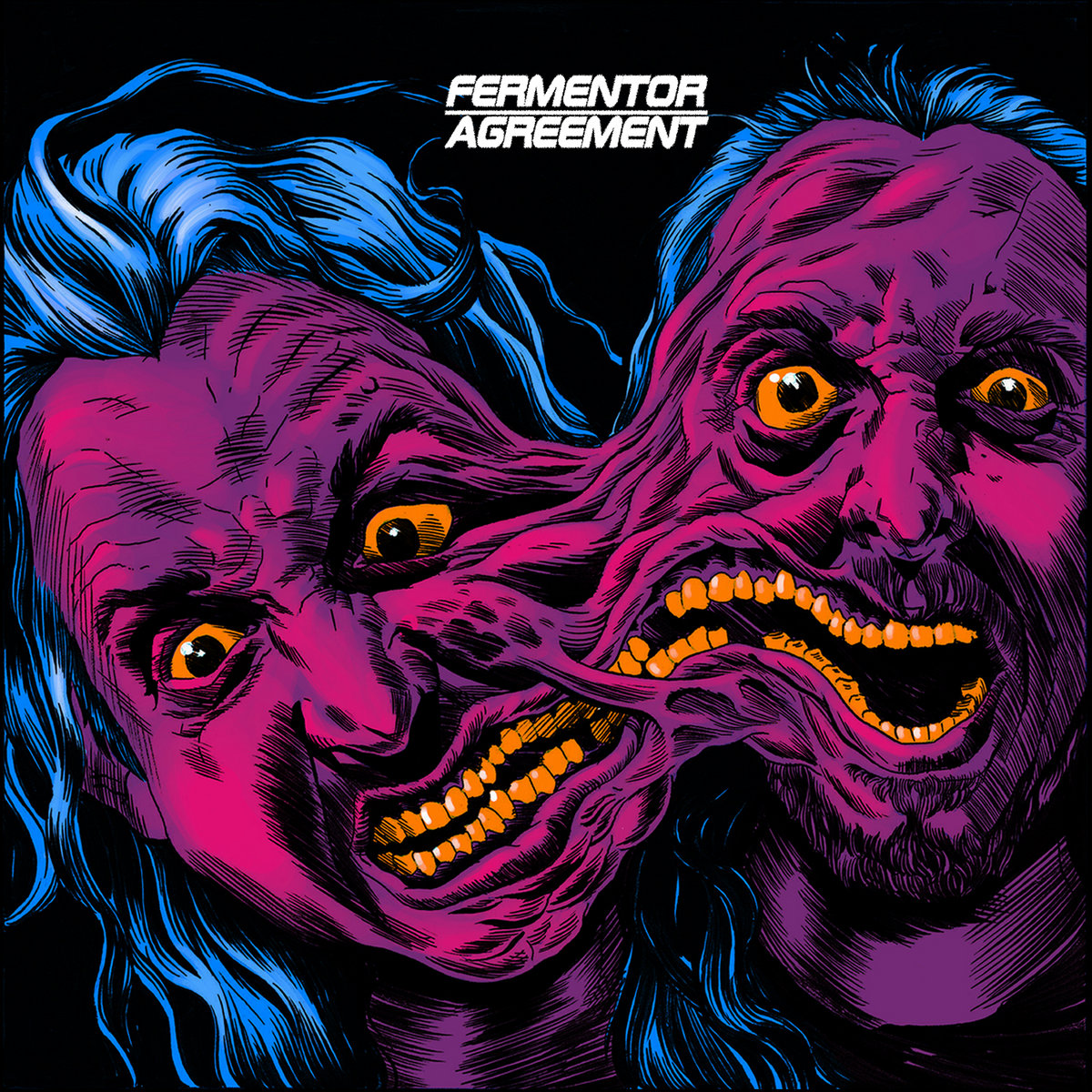
FERMENTOR: Agreement is kind of like the album cover itself: two distinct parts coming together, sometimes messy, sometimes unexpected, but always fused into something new. As a two-piece, making creative decisions feels a bit like merging two strong personalities without a referee. There is a lot of give and take, and occasionally things get a little tangled, but that is where the magic happens. Agreement also represents a shared understanding between us and our audience. We’re asking a lot, especially since this album moves away from our heavy metal roots and dives into more spontaneous, free-flowing improvisation. The songs are less polished and planned out, which means listeners need to come in with an open mind and be ready to really engage. In a way, the audience becomes part of the creative process, helping to shape how the music lands and feels.
ATN: What’s the biggest misconception people have when seeing you live for the first time?
FERMENTOR: People can be skeptical when they see we are just two members, but we put a lot of work into pushing past that stigma. Our sound should be massive and our performance should be energetic and dynamic. Ideally we challenge what people think is possible from a two-piece band, surprising the audience and proving that we can deliver a full and powerful performance.
ATN: How do you bring such complex improvised music to life on stage without relying on backing tracks?
FERMENTOR: We are yet to perform improvised music live, but this is absolutely one of our goals! It’s a scary concept but we are working towards it. We are writing new music though and it has been informed by our improvisation. We have begun incorporating looping into our written material and it requires a command of our parts and equipment as well as a lot of practice and patience. Fermentor isn’t against the use of backing tracks, but we like the idea of creating something from scratch in front of an audience.
ATN: If you could score any film or scene in cinema history, what would it be and why?
FERMENTOR: Well, our guitarist Wally has scored a film called Sign Man and it is available to watch for FREE on YouTube! (link below) We hope one day for Fermentor to score a feature, and something like the latest Mad Max films would be a good fit! Hit us up, Mr.Miller!
ATN: What’s a musical risk you’re dying to try next, even if it might completely fail?
FERMENTOR: Improvising live is the inevitable next step but the risk factor is off the charts so we will see when that actually happens
ATN: If your music had a warning label, what would it say?
FERMENTOR: WARNING! Fermentor may inspire uncontrollable delight and furious headbanging!
ATN: If Agreement was a physical object, what would it be and why?
FERMENTOR: On August 15, Agreement becomes a physical object in the form of a compact disc! We will be ushering in the physical release with a big show at Brick by Brick in San Diego on August 22!
ATN: What’s one piece of advice you’d give your past self before making this record?
FERMENTOR: You don’t have to do everything yourself! Hire a documentary crew!