
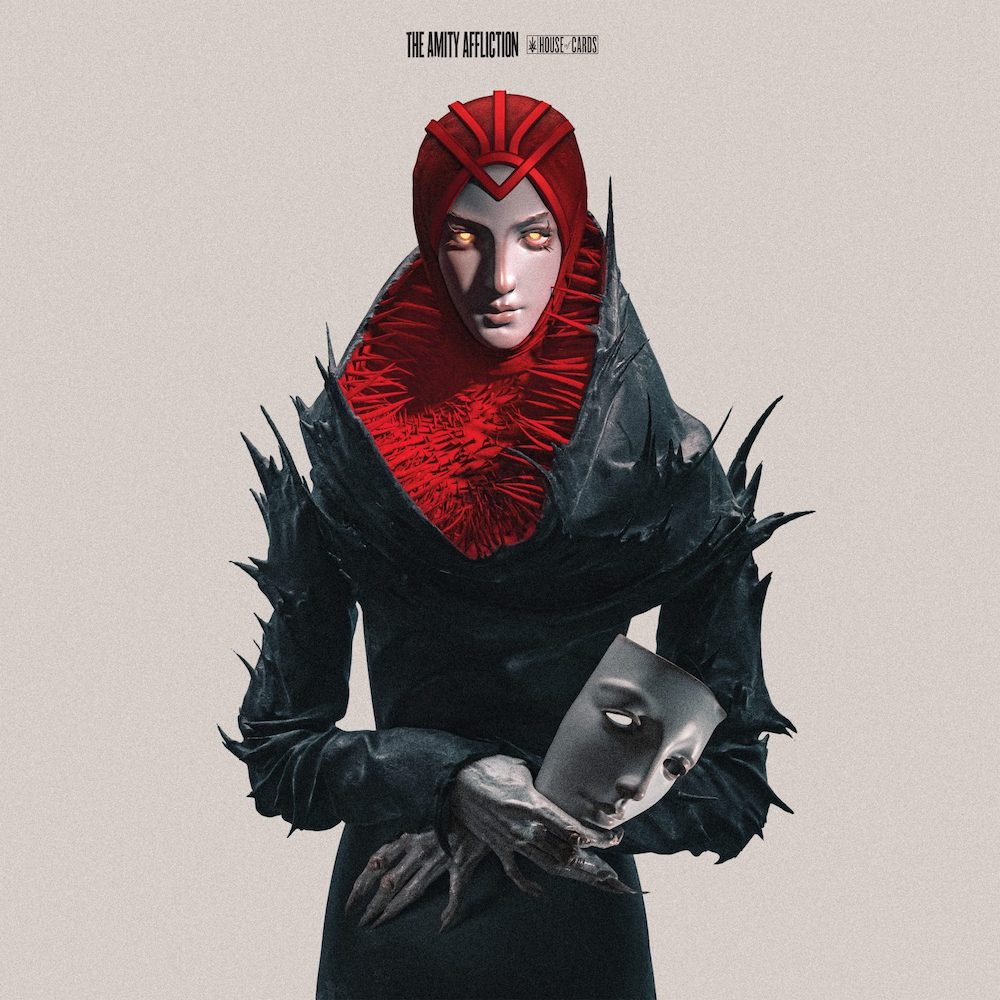
I spent my time absorbing House of Cards by The Amity Affliction. It wasn’t an easy listen, not because of the quality, but because of its brutal honesty. The album is a visceral and raw reaction to a past defined by trauma, abuse, and a love that was as volatile as it was hostile.
This is the first record to feature Jonathan Reeves on bass and vocals. Often, when a band undergoes a lineup change, the sound shifts but the most notable difference with Jonathan now in the fold is tonal. While Ahren Stringer’s clean vocals often had a tinny and high-pitched edge, Jonathan brings a more mellow and grounded tone to the melodies. It creates a new kind of friction against Joel Birch’s deep growls and raging howls.
The overarching theme is a painful excavation of family. Specifically Joel’s relationship with his mother and the ripple effect that bond had on his siblings and his own self-perception. This reality isn’t neatly explored. It’s a guttural and angry investigation where the blast beats of drummer Joe Longobardi and the sharp precision guitar work of Dan Brown help leave nothing unexamined.
The instrumental opener, “Vida Nueva (New Life),” carries a haunting atmosphere reminiscent of John Carpenter’s Halloween theme. It offers that same chilling premonition that something dark is looming. That tension is immediately shattered when “Kickboxer” unleashes years of cruelty and hate. While it may not be a literal primal scream, it feels like one. One of an unbroken spirit demanding to be felt deep in the chest where the heart rattles against the ribs.
The title track serves as an ode to Joel’s siblings, sharing the shared but different levels of hell they endured. It speaks to a bond that can either surrender to the dark or overcome it. This marks Jonathan’s first vocal appearance on the record, and his delivery captures a sense of hope that balances Joel’s rightful hurt.
In “Heaven Sent,” the band showcases the duality I’ve always loved about their sound. It’s a perfect yin and yang of brutality and melody. They have a finesse for catching the duality that proves music can be both punishing and beautiful at the same time. “Bleed” is three minutes and forty seconds of scorched earth and rage that is capped with a breathtaking breakdown. The song is best described as a face melter.
If one expects a moment to breathe, the band slides into “Break These Chains.” While the tempo is slightly softer, the lyrics are not. It’s an honest acceptance of hate that is paired with a readiness to let it go. This leads into the instrumental “Beso De La Muerte (Kiss of Death)”. Unlike the dread of the opener, this feels ethereal and spiritual and turns the looming dark feeling into a path toward healing.
Destined to be a live anthem, “Swan Dive” is a fist-pumping-sing-along that feels like hope coming up for air. It’s followed by the lyrical double edged sword of “Speaking in Tongues,” which I interpreted as acknowledging that a state of desolation might actually be better than the constant cycle of trauma. The upbeat energy of “Afterlife” and “Reap What You Sow” continues to lean into that brutal and beautiful duality before the closer, “Eternal War,” ends the record on a high note. It’s a final surge of cathartic screams and militant blast beats that are oddly filled with comfort.
House of Cards is feral, painfully emotional, ruthlessly raw, and a testament to the growth of a band not just as musicians, but as humans.