
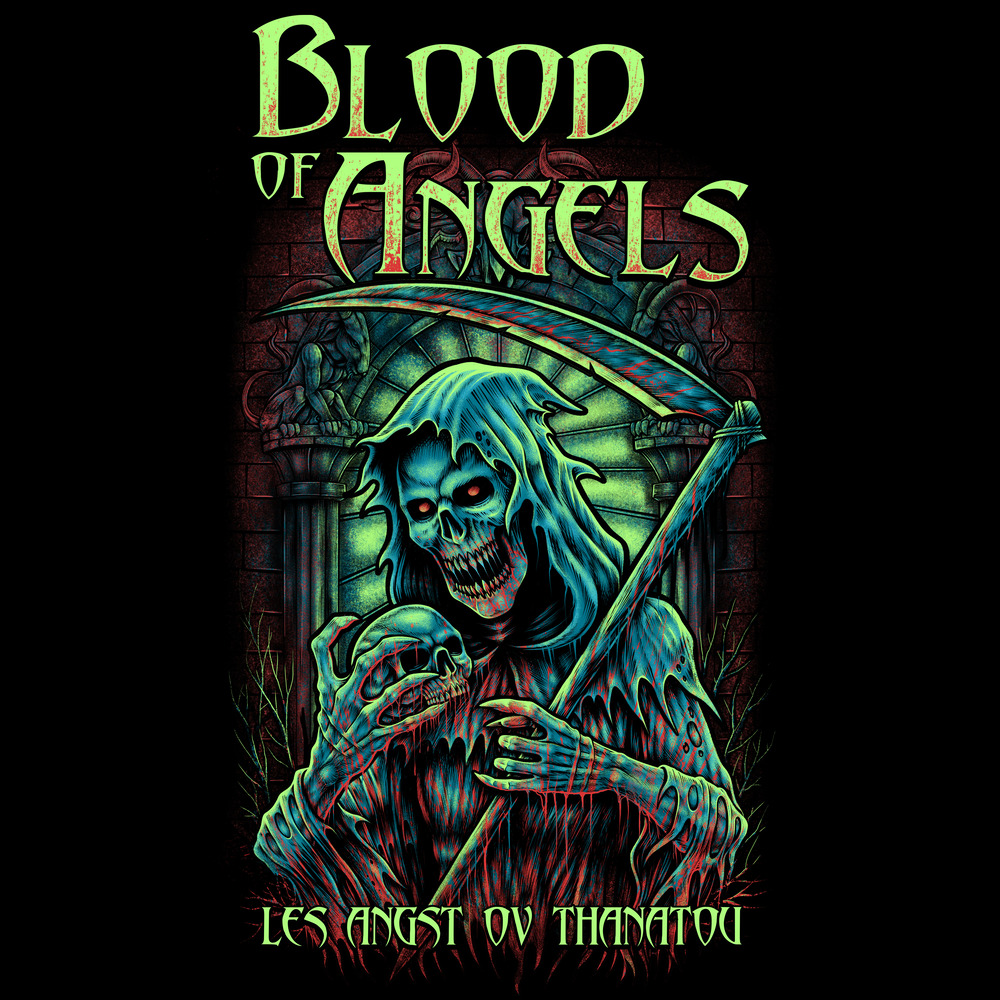
There is an inherent difficulty in capturing the exact architecture of grief without letting the music collapse under its own emotional weight. With their forthcoming full-length, Les Agnst ov Thanatou (June 21st), Tampa’s Blood of Angels bypass the typical, surface-level aggression of extreme metal to map out a deliberate psychological timeline of loss. It is an immersive conceptual record that examines mortality not as a shock tactic, but as an inevitable and fracturing human experience.
The album’s progression mirrors the actual, non-linear stages of mourning. Randy Reyes’ vocals anchor an opening movement that shifts from eerie into explosive bursts of denial and rage. Aaron Robinson’s guitar work handles this transition cleanly by balancing aggressive melodic riffs with suffocating textures. Rather than letting the record devolve into aimless chaos, Jonathan Rushford’s drumming and keyboards introduce structure with ceremonial-like rhythms midway through. It managed to mimic humanity’s instinct to find order in the aftermath of trauma.
The second half of the record turns sharply inward. By allowing The Maggot’s bass lines to drive heavier and more reflective movements, the songwriting slows down to explore survivor’s guilt and isolation. The production ensures these dense and layered arrangements have room to breathe and prevents the symphonic elements from burying the modern metal core while highlighting the band’s disciplined approach to dynamics. It is a sonic space where the persistence of memory feels tangible and heavy.
By the time the album reaches its final movements, it offers no false comfort. Les Agnst ov Thanatou concludes with a stark and atmospheric acknowledgment of finality. Blood of Angels have delivered a record that feels like a necessary catharsis. One that emphasises the impact of loss rather than finding peace.